
Think Your Business Finances Are Organized? Check These 7 Things

You can have a business bank account, bookkeeping software, a folder full of receipts, and a profit and loss statement sitting right in front of you and still not feel like your business finances are organized.
That’s because financial organization is not really about having all the pieces.
It’s about knowing that the pieces agree with each other.
If you’re trying to figure out how to organize business finances, I wouldn’t start by creating more folders or downloading another app. I would start by checking whether the bookkeeping you already have can answer seven basic questions.
These are the same kinds of things I want to know before I trust a set of books enough to rely on the reports.
The 7-Point Financial Organization Check
At a glance, I want to know:
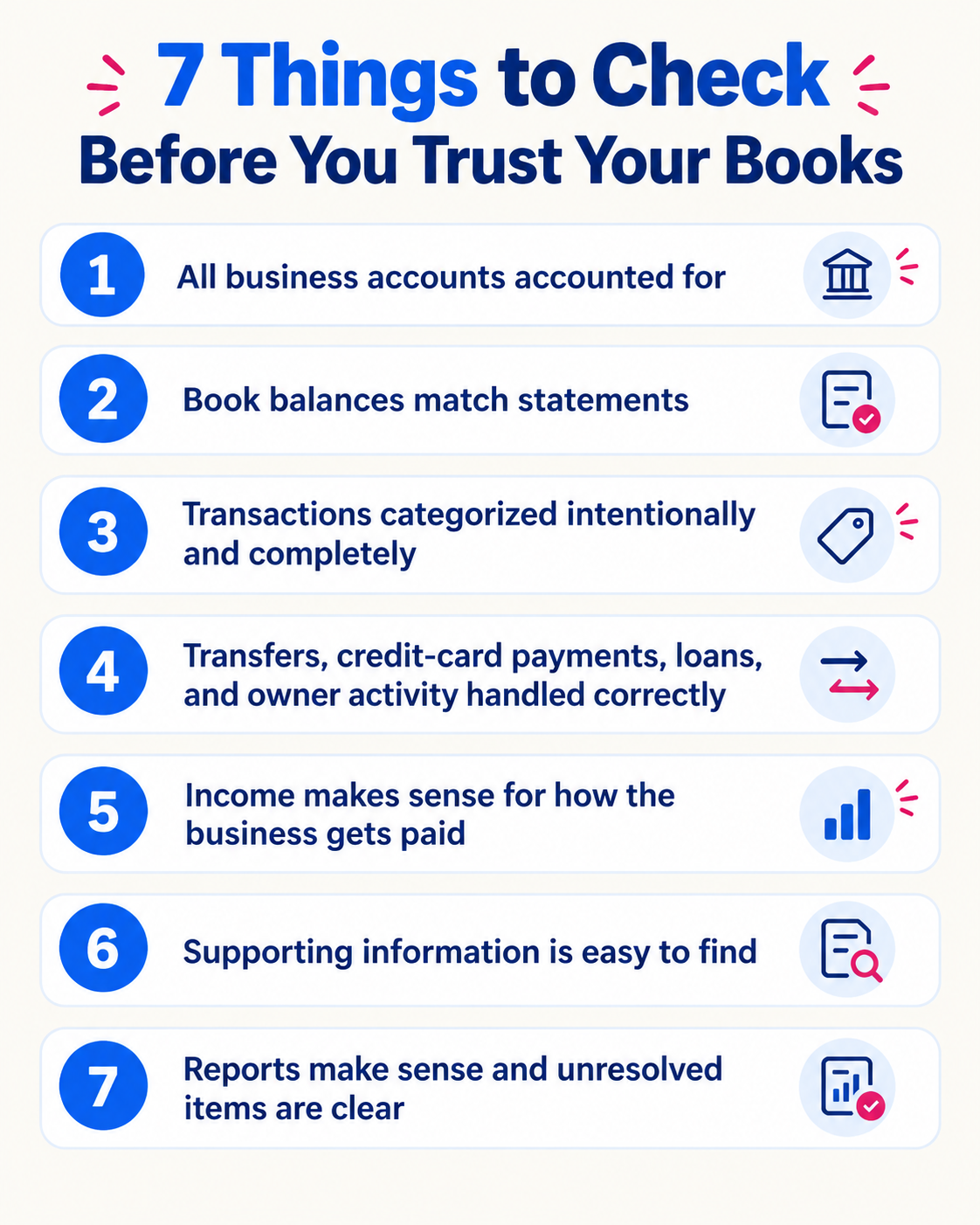
Are all of the business accounts accounted for?
Do the bookkeeping balances match the real account statements?
Are the transactions categorized intentionally and completely?
Were transfers, credit-card payments, loans, and owner activity handled correctly?
Does the income in the books make sense for how the business actually gets paid?
Can you find the supporting information when a transaction needs an explanation?
Do the reports make sense, and do you know what is still unresolved?
You do not need perfect books before you can improve them. But you should be able to tell which of these seven areas is solid and which one still needs attention.
1️⃣ Are All of Your Business Accounts Actually in the Books?
Start with the accounts where business money moves.
That may include:
business checking and savings accounts
business credit cards
payment processors such as Stripe, Square, PayPal, or merchant services
loans and lines of credit
cash accounts, if your business uses cash
other accounts that regularly hold or move business funds
It sounds basic, but this is one of the first places financial organization breaks down.
An old credit card is still being used but is not connected. A savings account exists but never gets reviewed. A payment processor deposits net amounts into checking, while the fees and gross sales are never properly recorded.
If an account affects the business, it needs to be part of the financial picture.
🎯 Quick check
Make a simple list of every place business money currently sits or moves. Compare that list to the accounts in your bookkeeping system.
If something is missing, fix that before worrying about prettier reports.
2️⃣ Do the Bookkeeping Balances Match the Real Statements?
A balance on a screen is not proof that the balance is right.
This is what reconciliation is for.
When you reconcile an account, you are confirming that the activity in the books agrees with the activity on the actual bank or credit-card statement for the same period.
That catches things a bank feed alone cannot reliably catch, including:
duplicated transactions
missing transactions
transactions entered for the wrong amount
payments or deposits recorded twice
old items that never cleared
beginning-balance problems
If your checking account says $12,418.22 at month-end and the bookkeeping system says $14,903.67, I do not care how neat the categories look yet. We have a more important question to answer first.
🎯 Quick check
Look at the most recent reconciliation date for every bank and credit-card account.
If you cannot tell whether the accounts are reconciled through the latest completed month, put that near the top of your cleanup list.
3️⃣ Are Transactions Categorized Intentionally, Not Just Cleared From the Feed?
A cleared bank feed can feel very satisfying.
It can also create a false sense of completion.
Every transaction having a category does not automatically mean every transaction has the right category.
Before I trust the books, I want to know whether the categories reflect what actually happened in the business.
That means watching for things such as:
uncategorized income or expenses
Ask My Accountant or similar holding categories that have quietly accumulated
vendors that are always assigned the same category even though the purchases vary
personal expenses mixed with business expenses
expenses that should be split between multiple categories
large purchases that may need different treatment than an ordinary operating expense
Software suggestions can speed this work up. They should not replace understanding the transaction.
🎯 Quick check
Scan the profit and loss statement and transaction detail for uncategorized accounts, unusually large categories, and anything that makes you stop and think, “Why is that there?”
That reaction is useful. Follow it.
4️⃣ Were Transfers, Credit-Card Payments, Loans, and Owner Activity Handled Correctly?
Some of the most common bookkeeping mistakes happen when money moves but is not actually new income or a new expense.
For example:
moving money from checking to savings is a transfer
paying a business credit card is paying down the card balance, not creating the original expenses again
receiving loan proceeds is not ordinary business income
paying a loan usually involves both principal and interest
an owner contribution is different from sales revenue
an owner draw or distribution is different from a business operating expense
If those transactions are treated incorrectly, the reports can look believable while still being wrong.
That is why I pay close attention to money moving between accounts, debt, and owner activity before I rely heavily on the profit and loss statement.
🎯 Quick check
Look at recent transfers, credit-card payments, loan deposits/payments, and owner transactions. Make sure they are not inflating income or expenses simply because money entered or left a bank account.
5️⃣ Does the Income in the Books Match How Your Business Actually Gets Paid?
The income section should make sense when you compare it with the way the business operates.
If you invoice customers, are the payments being handled consistently?
If Stripe or Square sends net deposits after fees, are you recording the full picture correctly rather than treating every net deposit as the whole sale?
If a large deposit came from a loan, owner contribution, refund, or transfer, did it accidentally become revenue?
The bank account tells you money arrived.
It does not always tell you why it arrived.
That distinction matters.
🎯 Quick check
Pick the largest deposits from the last month and ask whether you can explain each one. The income in the books should agree with the real story of how the business earned and received money.
6️⃣ Can You Find the Supporting Information When You Need It?
Financial organization is not the same thing as saving every receipt in a beautiful folder structure.
The test is much simpler:
When a transaction needs an explanation, can you find what you need without starting a scavenger hunt?
Depending on the transaction, that support might be:
a receipt
an invoice
a contract
an email confirmation
a loan statement
a payroll report
a note explaining the business purpose
You do not need to attach a document to every five-dollar transaction just because a system lets you.
You do need a reliable way to keep the information that matters.
🎯 Quick check
Choose three transactions from last month that would be hard to explain from the bank description alone. See how quickly you can find the supporting information.
If you cannot, that is an organization problem worth fixing while the details are still recent.
7️⃣ Do the Reports Make Sense, and Do You Know What Is Still Unresolved?
This is the final test.
Open the profit and loss statement and balance sheet.
Do not just look at the totals. Ask whether the reports describe the business you know you are running.
Look for things such as:
income that seems much higher or lower than expected
expense categories with unusual spikes
negative bank or credit-card balances that do not make sense
loan balances that have not changed even though payments are being made
large Uncategorized or Ask My Accountant balances
owner equity accounts that do not fit what actually happened
old balances that nobody can explain
You do not have to understand every accounting detail on sight.
But you should not be afraid to look at the reports because you have no idea whether they can be trusted.
And if something is still unresolved, make it visible.
A short open-items list is far more useful than pretending the books are finished because every transaction disappeared from the feed.
🎯 Quick check
Write down every balance, category, or transaction you still have a question about. If the list exists somewhere you will actually revisit it, the bookkeeping can move forward without those questions disappearing.
What “Financially Organized” Actually Means
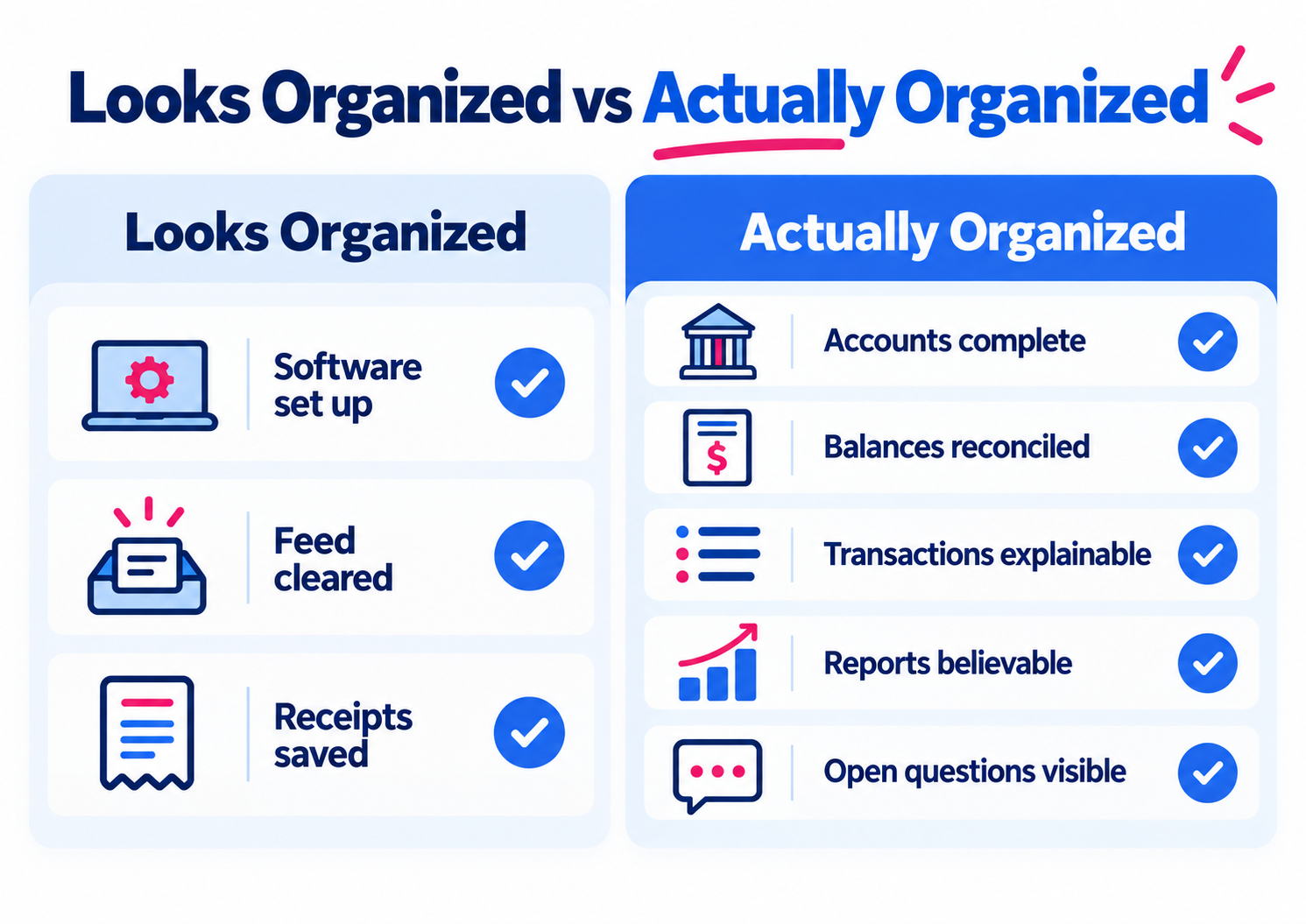
You do not need a perfect bookkeeping system with color-coded folders and zero unanswered questions.
You need control over the basics.
Financially organized means you can tell:
where the business money is
whether the account balances are accurate
what the transactions were
which money movements are not income or expenses
where the income came from
where to find supporting information
what the reports are telling you
what still needs an answer
That is a much more useful standard than “my bank feed is empty.”
If Several of These Checks Failed
Do not try to fix all seven at once.
Start in this order:
Make sure all accounts are included.
Reconcile the accounts.
Resolve the transactions and money movements that are wrong or unclear.
Clean up the supporting records and open questions.
Review the reports again after the underlying books are reliable.
And once you are current, keep the work from piling back up.
My weekly bookkeeping routine is Capture → Categorize → Check → Confirm. You can use the full checklist here: Weekly Bookkeeping Checklist: The 4-Step Routine That Keeps Your Books Current.
Financial organization is not a one-time cleanup project. It is a condition you maintain.
The good news is that once the basics are in place, maintaining them is much easier than rebuilding them every few months.
Common Questions About Organizing Business Finances
-
Your books are organized when you can account for all of the business accounts, the balances agree with the real statements, transactions make sense, supporting information is easy to find, and the reports reflect what is actually happening in the business. An empty bank feed by itself is not enough.
-
Yes. For accounts that are reconciled, the bookkeeping balance should agree with the statement balance for the same period after any legitimate outstanding items are considered. If the balances do not agree, there is something to investigate before relying on the reports.
-
Clearing the bank feed means you have reviewed or categorized the transactions that came into the software. Reconciliation is a separate check that confirms the activity and ending balance in the books agree with the actual bank or credit-card statement. You can have a completely cleared feed and still have an unreconciled account.
-
Absolutely. Software can be set up, receipts can be saved, and every transaction can have a category while the books still contain duplicates, missing activity, incorrect transfers, or balances that do not reconcile. That is why organization has to include accuracy and explainability, not just tidy-looking records.
-
I would review the books regularly as part of your normal bookkeeping routine, then do a more complete check at least monthly when you reconcile the accounts and review the reports. The sooner you catch a problem, the easier it usually is to explain and correct.
-
Start with the issue that affects the foundation of the books first. Make sure all accounts are included, reconcile the balances, then work through incorrect or unclear transactions. Keep a short list of anything you cannot resolve right away so those questions stay visible instead of getting buried
Read more from OYB on Substack:
If I Took Over Your Books Tomorrow, These Are the 7 Things I’d Check First
If you do your own bookkeeping and want practical help understanding what to check, what matters, and how your numbers fit together, subscribe to Own Your Bookkeeping.