
How to Understand Your Bookkeeping Instead of Just Keeping It Up to Date

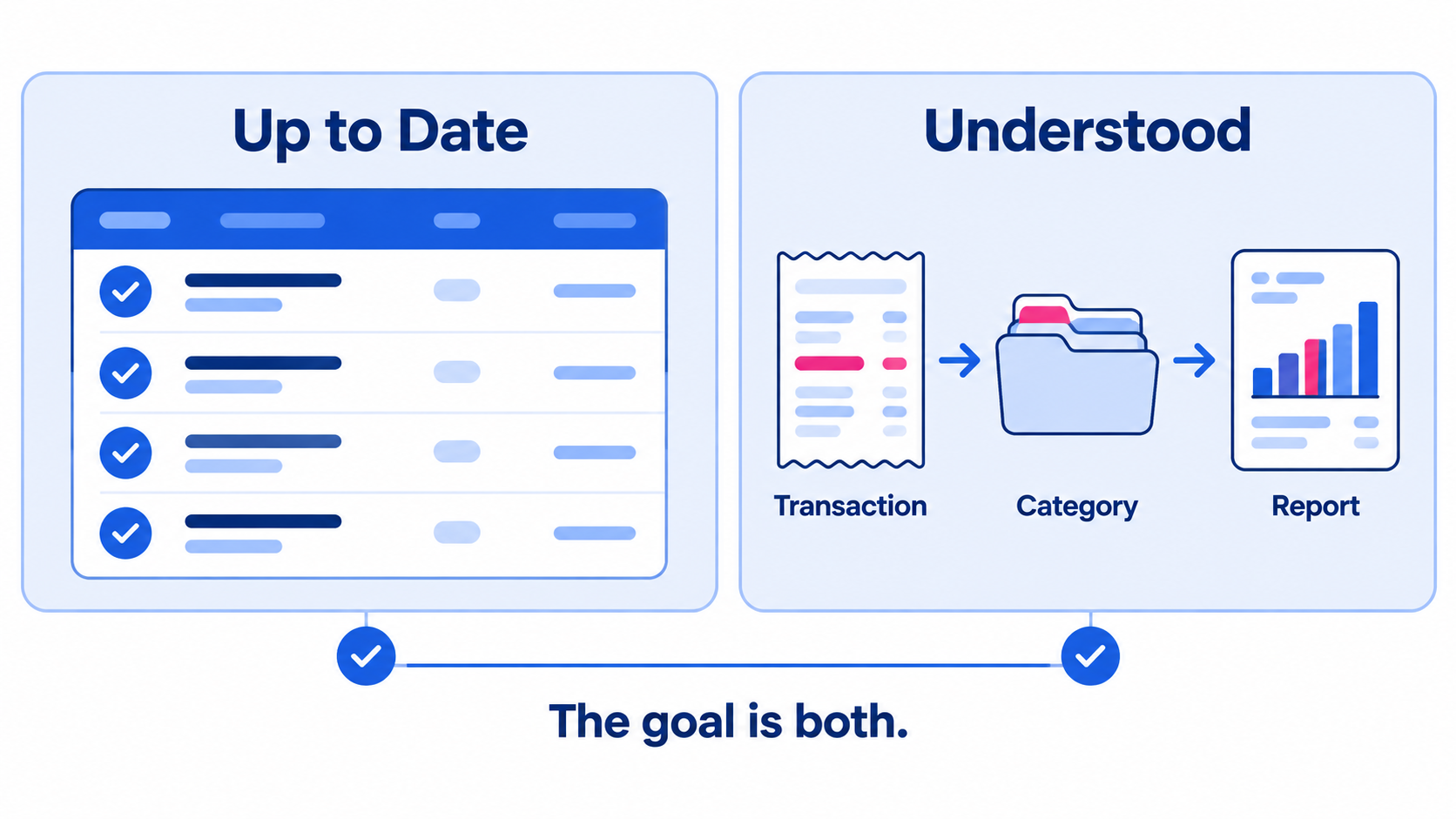
A bookkeeping system can be completely up to date and still leave the business owner confused.
Every transaction has a category.
The bank feed is cleared.
Accounts may even be reconciled.
But when the owner opens a report, the numbers still feel disconnected from the work they have been doing.
If you want to understand your bookkeeping, the goal is not to memorize accounting terminology.
It is to connect:
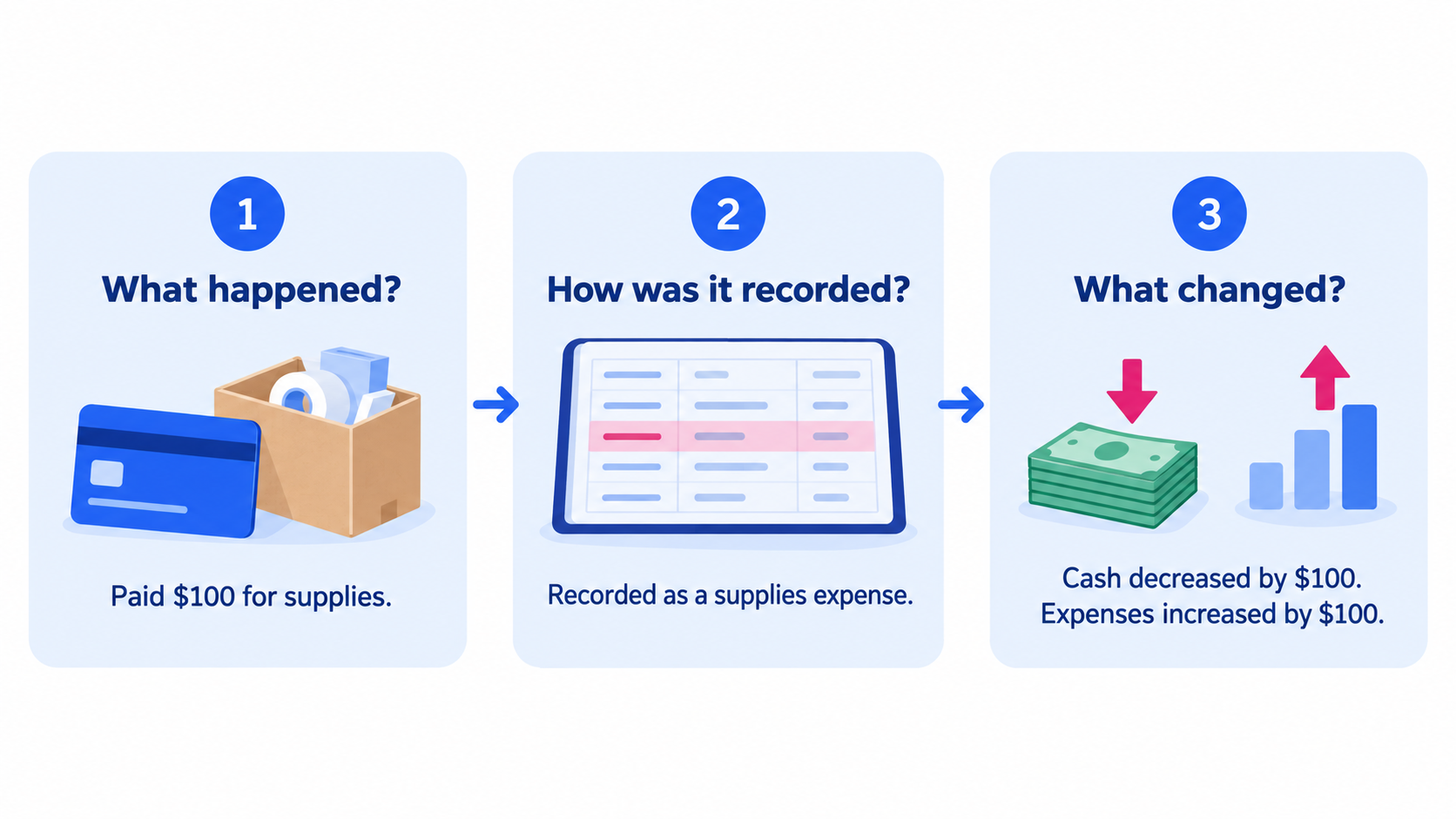
what happened → how it was recorded → what changed in the financial picture
These five questions are a practical way to do that.
1️⃣ What actually happened in the business?
Start before the category.
What real event took place?
A customer paid an invoice. Money moved from checking to savings. The business made a loan payment. The owner put money into the business. A credit card was paid.
A merchant name is a clue. A withdrawal is a clue. A deposit is a clue.
The bookkeeping answer depends on what actually happened.
If the information you need to figure that out is scattered across email, downloads, paper, and different apps, start with the five-home system for organizing business financial records.
2️⃣ Why is this transaction in this category?
Once you know what happened, ask why the selected category makes sense.
A recurring Adobe charge may reasonably belong to software or subscriptions.
Amazon is different. It could be office supplies, equipment, job materials, a mixed order, or personal.
Prior treatment can be useful evidence. It should not replace context.
For more on that distinction, read Up to Date Is Not the Same as Understood.
3️⃣ What did this transaction change?
You do not have to answer with debits and credits.
Did it:
reduce cash?
increase an expense?
increase revenue?
pay down debt?
move money between accounts?
increase an asset?
change owner equity?
Example: credit-card payment
Checking decreases and the credit-card liability decreases. The payment is not automatically another expense because the underlying purchases should already be recorded.
Example: loan deposit
Cash increases and debt increases. Revenue does not automatically increase.
4️⃣ Does the report make sense afterward?
Bookkeeping is not finished when the feed is empty.
After the month is reconciled, ask:
Does revenue look reasonable?
Are major expenses in the range you expected?
Did a category suddenly disappear?
Did an unusual amount appear?
Do loan and credit-card balances look plausible?
Are owner contributions and draws separated from income and expenses?
A transaction can be “categorized” and still create a result that should make you stop.
5️⃣ Could you explain the number to someone else?
This is my favorite test.
If your accountant asks why the loan balance changed, can you point to the payments?
If profit dropped, can you identify the major change?
If cash rose sharply, do you know whether it came from customers, debt, or owner funding? If that distinction is still fuzzy, it helps to understand why bank balance and profit are different.
If you can explain the number in ordinary business language, the books are becoming useful.
Understanding does not mean doing everything manually
Automation can make bookkeeping easier.
Software can import transactions, recognize vendors, remember prior activity, surface likely matches, flag possible duplicates, and suggest categories.
The best workflow removes repetitive work while preserving enough context for you to understand what changed.
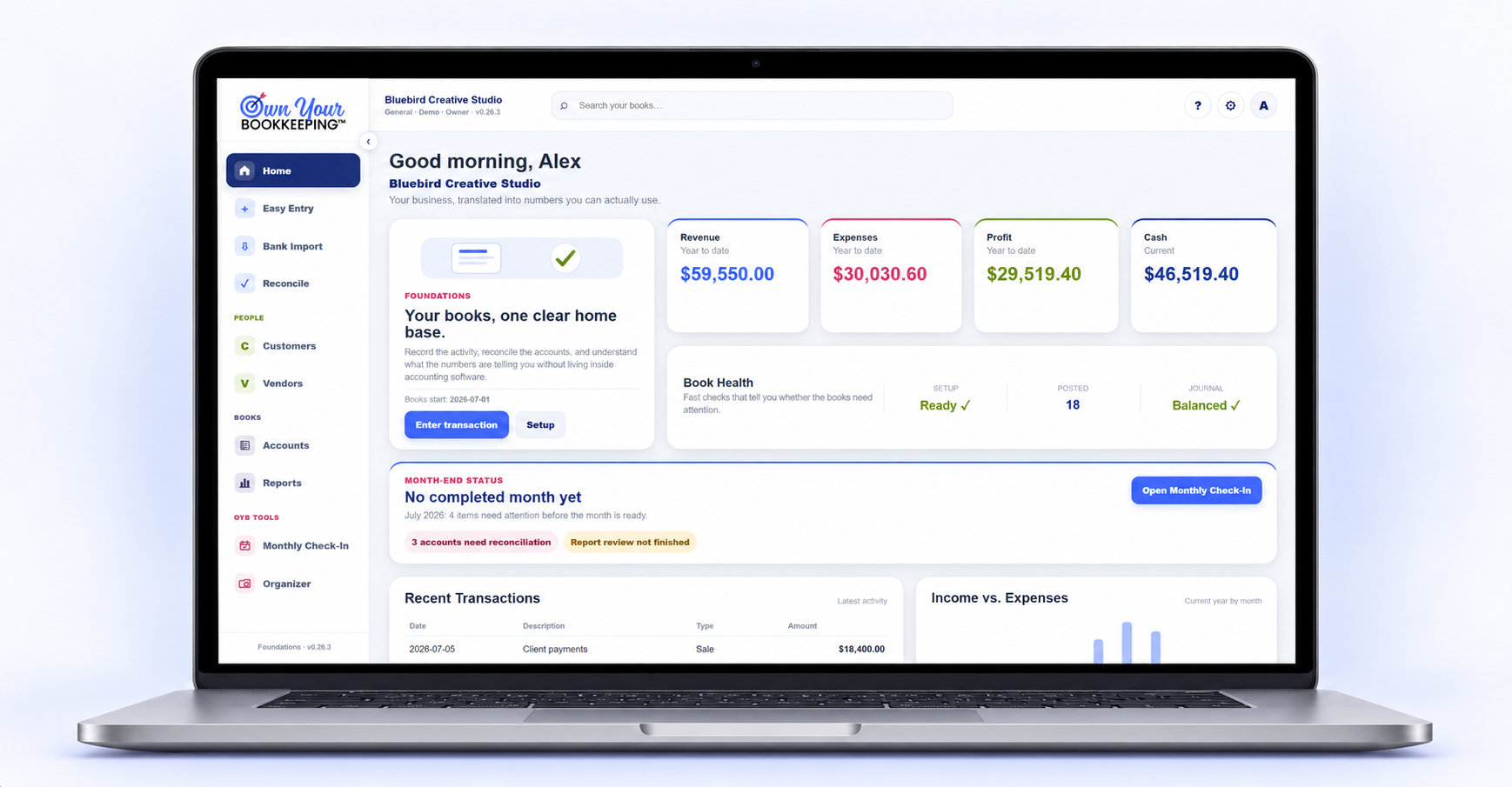
That is the approach behind OYB Foundations: software should assist your bookkeeping without making you disappear from it.
A monthly routine for understanding your books
Step 1: Review the P&L
Look at revenue, major expenses, and profit. Ask what changed from the prior month.
Step 2: Review the balance sheet
Look at bank accounts, credit cards, loans, owner equity, and receivables/payables if applicable.
Step 3: Pick three unusual numbers
Choose the amounts that look most surprising and trace them back to activity.
Step 4: Ask what changed operationally
Did the business sell more, spend more, buy equipment, take on debt, or make a large owner draw?
Step 5: Write down the questions
You do not need to solve every accounting question alone. Notice what you do not understand while the month is still fresh.
Common questions about understanding bookkeeping
-
You need enough understanding to recognize common transaction types, review your work, reconcile accounts, and understand the basic reports. You do not need to become an accountant.
-
Start with reconciled bank and credit-card accounts, then review whether the P&L and balance sheet make sense. Look for unusual balances and transactions that need context.
-
At minimum, learn the basic purpose of the profit and loss statement and balance sheet. A cash-flow statement can also help explain why cash changed differently from profit.
-
Bookkeeping records and organizes financial activity. Financial statements summarize the result. Understanding the statements means connecting those summarized numbers back to what happened.
-
Good software can explain suggestions, show prior patterns, make transaction effects visible, and guide review. It should reduce unnecessary work without hiding the logic.
The takeaway
Ask:
What happened?
Why is it categorized this way?
What did it change?
Does the report make sense afterward?
Could I explain the number?
If you can answer those questions more often than not, your books are becoming more than current.
They are becoming useful.
Foundations is being built around this principle: make the repetitive work easier while keeping the bookkeeping understandable. See what OYB Foundations is being built to do.
Get the next post in your inbox.
When a new post goes up, you'll get an email with the link. Nothing else.
Something went wrong. Please try again.
No spam. Unsubscribe anytime.
You're on the list.
Check your inbox to confirm your email. You'll hear from me when the next post goes up.