
Your Bank Balance Is Not Your Profit. Here’s Why That Matters.

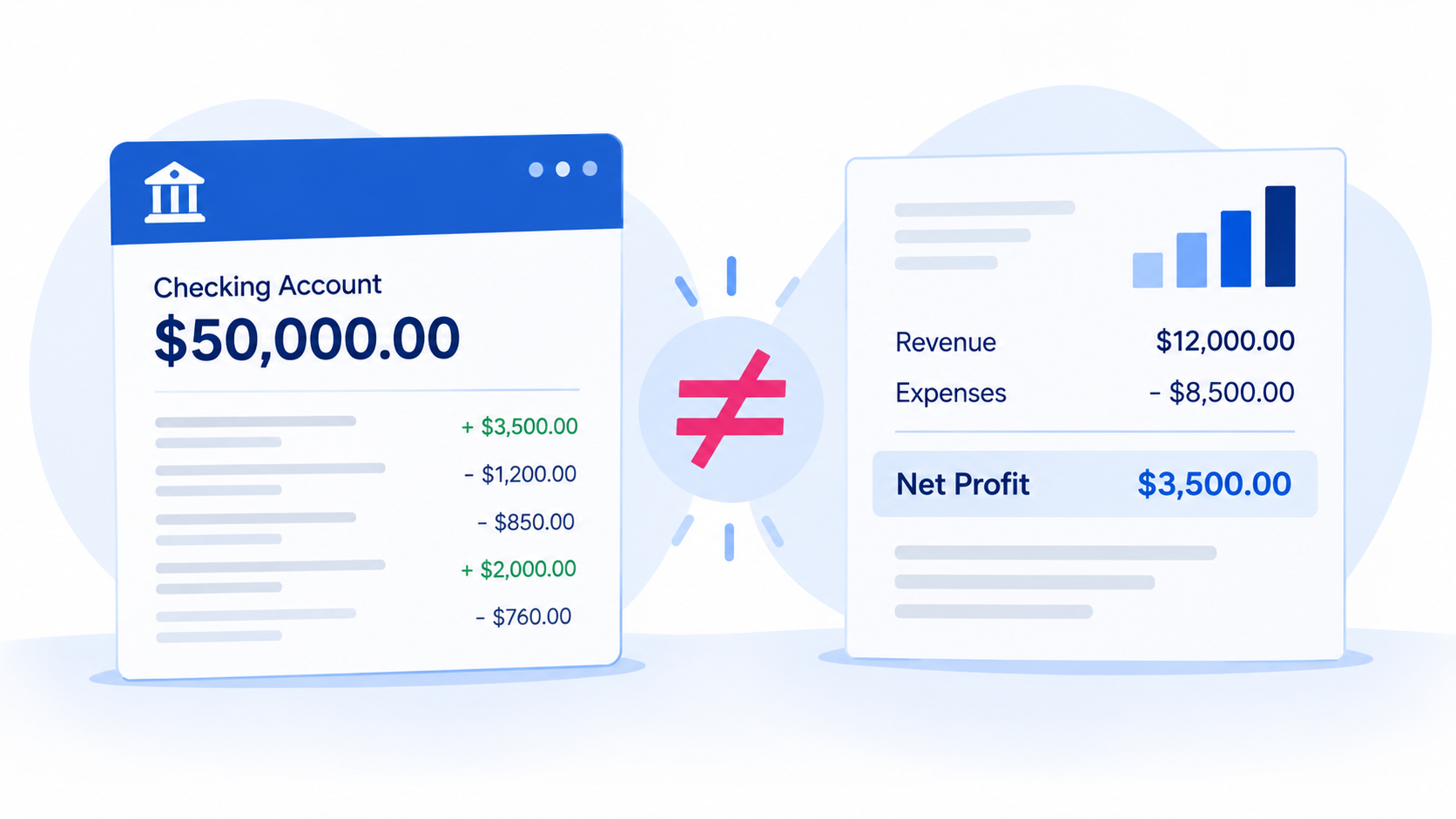
A business can have $50,000 in the bank and very little profit.
It can also show a healthy profit on the profit and loss statement while the checking account feels uncomfortably low.
Neither situation means the bookkeeping is wrong.
It means cash and profit measure different things.
Understanding the difference between bank balance vs profit is one of the most useful bookkeeping concepts a business owner can learn because both numbers affect decisions, but they answer different questions. If you are not yet sure whether the numbers behind those decisions are reliable, start with these 7 checks for organized business finances.
Bank balance and profit answer different questions
Your bank balance tells you how much cash is sitting in the account at a particular moment.
Your profit tells you whether the business earned more revenue than it incurred in expenses over a period of time.
Those are not interchangeable.
Bank balance asks:
How much cash is here right now?
Profit asks:
Did the business earn more than it spent during this period?
The bank account measures a point in time.
The P&L measures financial performance across a period.
That is why the two numbers can move in completely different ways.
Why a high bank balance can exist with low profit
A large cash balance can feel like proof that the business is doing well.
Sometimes it is.
But cash can enter the account for reasons that have nothing to do with profit.
1️⃣ Loan proceeds
If the business borrows $40,000, the bank balance increases by $40,000. Profit does not. A loan creates cash and debt at the same time.
2️⃣ Owner contributions
If an owner puts $20,000 of personal money into the business, checking goes up. The business did not earn $20,000.
3️⃣ Customer deposits or prepayments
Money collected now may still need to fund future work. The cash balance alone cannot tell you the economic story.
4️⃣ Bills have not been paid yet
A business can have strong cash today while payroll, credit cards, taxes, and vendor bills are about to pull that cash out.
5️⃣ Credit cards delay the cash outflow
An expense can already reduce profit even though the cash will not leave the checking account until the card is paid.
Why a profitable business can still be short on cash
The opposite situation is just as common.
1️⃣ Customers have not paid yet
Revenue and cash do not always arrive at the same time.
2️⃣ Loan principal payments use cash but are not ordinary expenses
Part of a loan payment may reduce the liability rather than profit.
3️⃣ Equipment purchases can use a lot of cash
The cash impact and profit impact can happen on different timelines.
4️⃣ Owner draws and distributions use cash
Cash decreases, but the withdrawal is not automatically a business expense.
5️⃣ Taxes move cash
Tax and liability payments can reduce cash without matching the P&L in the way an ordinary operating expense would.
A simple bank balance vs profit example
Business A
Checking balance: $60,000
Monthly profit: $4,000
But $30,000 came from a new loan, $10,000 is needed for payroll and taxes, and the business has a $7,500 credit-card balance.
Business B
Checking balance: $18,000
Monthly profit: $22,000
The business also paid down debt, bought equipment, made an owner distribution, and is waiting for several customers to pay.
Same lesson: cash and profit tell different parts of the story.
Why the bank balance is not a spending limit
Before a meaningful purchase, look at:
Cash currently available
Bills, payroll, taxes and other short-term obligations
Current profit
Expected cash inflows and outflows
You do not need a complicated financial model every time. You need enough context to know whether the money in checking is already spoken for.
That check is much easier when the records behind the numbers are not scattered. If yours are, use the five-home financial-record system.
For a quick version of this decision check, see Before You Spend What’s in the Bank, Check These 4 Numbers.
Which report tells you profit?
Profit is generally found on the profit and loss statement, also called the income statement.
The P&L summarizes revenue, cost of goods sold when applicable, operating expenses, and the resulting profit or loss.
It does not tell you exactly how much cash is in checking. That is not a flaw. It is doing a different job. The same principle applies to the software itself: simple bookkeeping software should help you review, reconcile, and understand the reports without hiding what is happening.
Which report helps explain where the cash went?
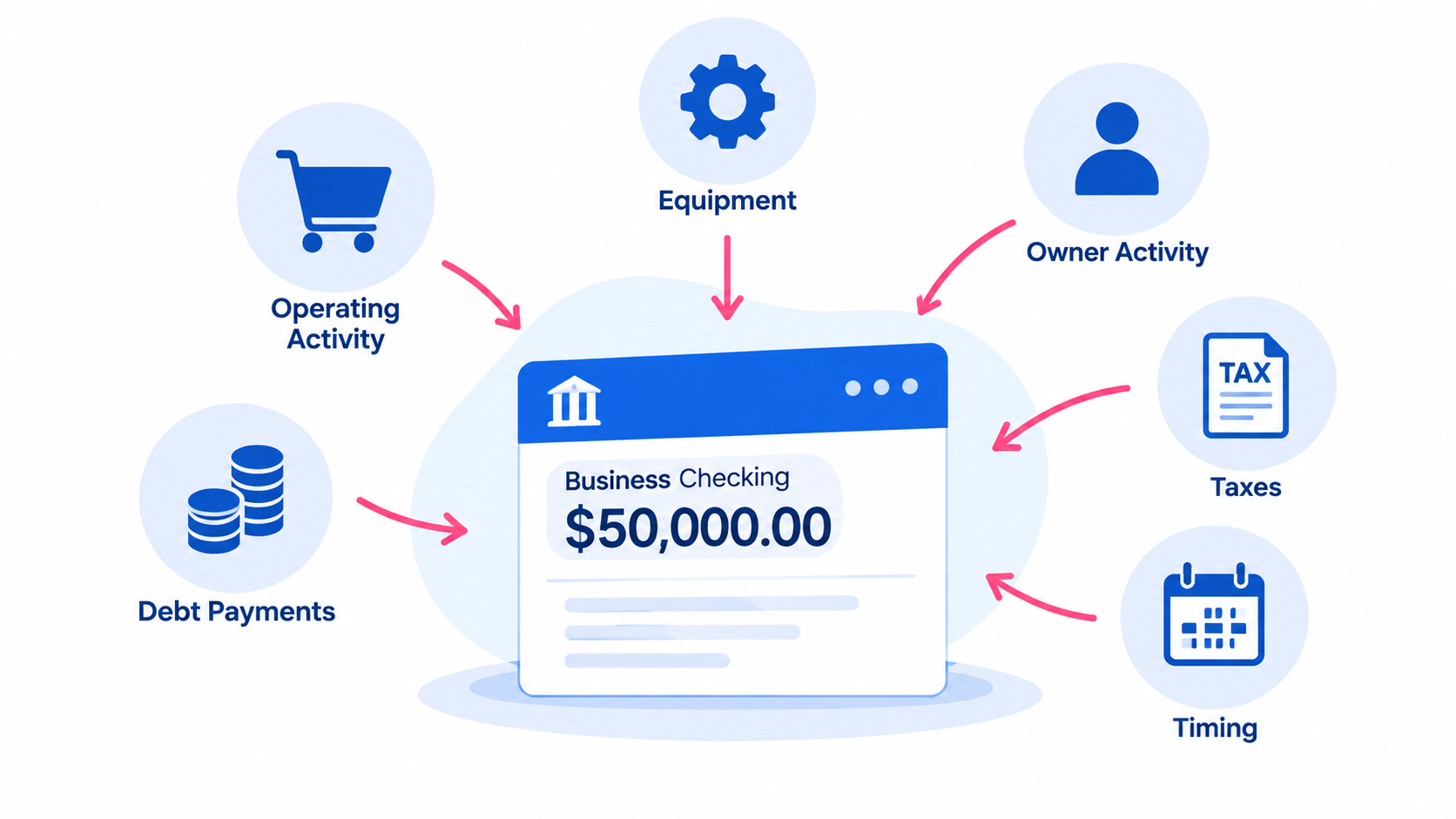
If profit looks good but cash is lower than expected, look at:
balance-sheet changes
loan balances
owner equity/activity
accounts receivable
accounts payable
credit-card balances
fixed-asset purchases
tax liabilities
transfers between accounts
The cash-flow statement can also help explain how operating, investing and financing activity affected cash.
Bank balance vs profit: what should you watch regularly?
Weekly
A quick cash check can help with upcoming payments and immediate decisions. If you want a simple rhythm for the rest of the bookkeeping too, use the 4-step weekly bookkeeping checklist.
Monthly
Review the P&L after the books are reconciled so you can see how the business actually performed. If you are not sure whether you can trust the numbers yet, start with 7 things a bookkeeper checks before trusting the books.
Then compare the two.
If cash rose but profit was weak, ask where the cash came from.
If profit was strong but cash fell, ask where the cash went.
Common questions about bank balance vs profit
-
Not automatically. Cash in the bank may include revenue, loan proceeds, owner contributions, customer deposits, or money reserved for upcoming obligations.
-
Yes. Cash can be tied up in receivables, used to repay debt, spent on equipment, distributed to owners, or used for other balance-sheet activity.
-
Possible reasons include loans, owner contributions, unpaid bills, credit-card balances, customer deposits, timing differences, or cash accumulated from earlier periods.
-
Cash may have been used for debt principal, equipment, taxes, owner distributions, or other activity that does not appear as an ordinary expense on the P&L.
-
Use it as one input, not the only input. Check upcoming obligations, current profitability, and expected cash movement before making a significant spending decision.
The takeaway
Cash tells you what is available now.
Profit tells you what the business earned over time.
A business owner needs both views to make a good decision.
For a quick decision check, read Before You Spend What’s in the Bank, Check These 4 Numbers.
Get the next post in your inbox.
When a new post goes up, you'll get an email with the link. Nothing else.
Something went wrong. Please try again.
No spam. Unsubscribe anytime.
You're on the list.
Check your inbox to confirm your email. You'll hear from me when the next post goes up.