

You buy a $640 piece of equipment for your business. Four months later, it stops working.
The seller asks for proof of purchase before helping with a warranty claim.
You open your bookkeeping software. There's the $640 charge, neatly recorded. You even know which expense category it went into.
But that transaction doesn't tell the seller exactly what you bought, which model it was, or what the final invoice said.
And now you're searching through four months of email for the receipt.
The first time you need a business receipt might have nothing to do with taxes.
Receipts help explain purchases, sure. But they can also help you get your money back, resolve billing problems, and prove what your business bought. Here's where they earn their keep the rest of the year.
1️⃣ When you need to return something
Maybe the office chair arrived damaged. A package contained the wrong supplies. Or an online order showed up with only half the items.
You contact the seller and get the question you weren't expecting: Can you send the original receipt or order number?
Your bank statement shows the total charge, but it doesn't necessarily show which chair, which items, or which discount applied. A final, itemized receipt or invoice can make the conversation much easier.
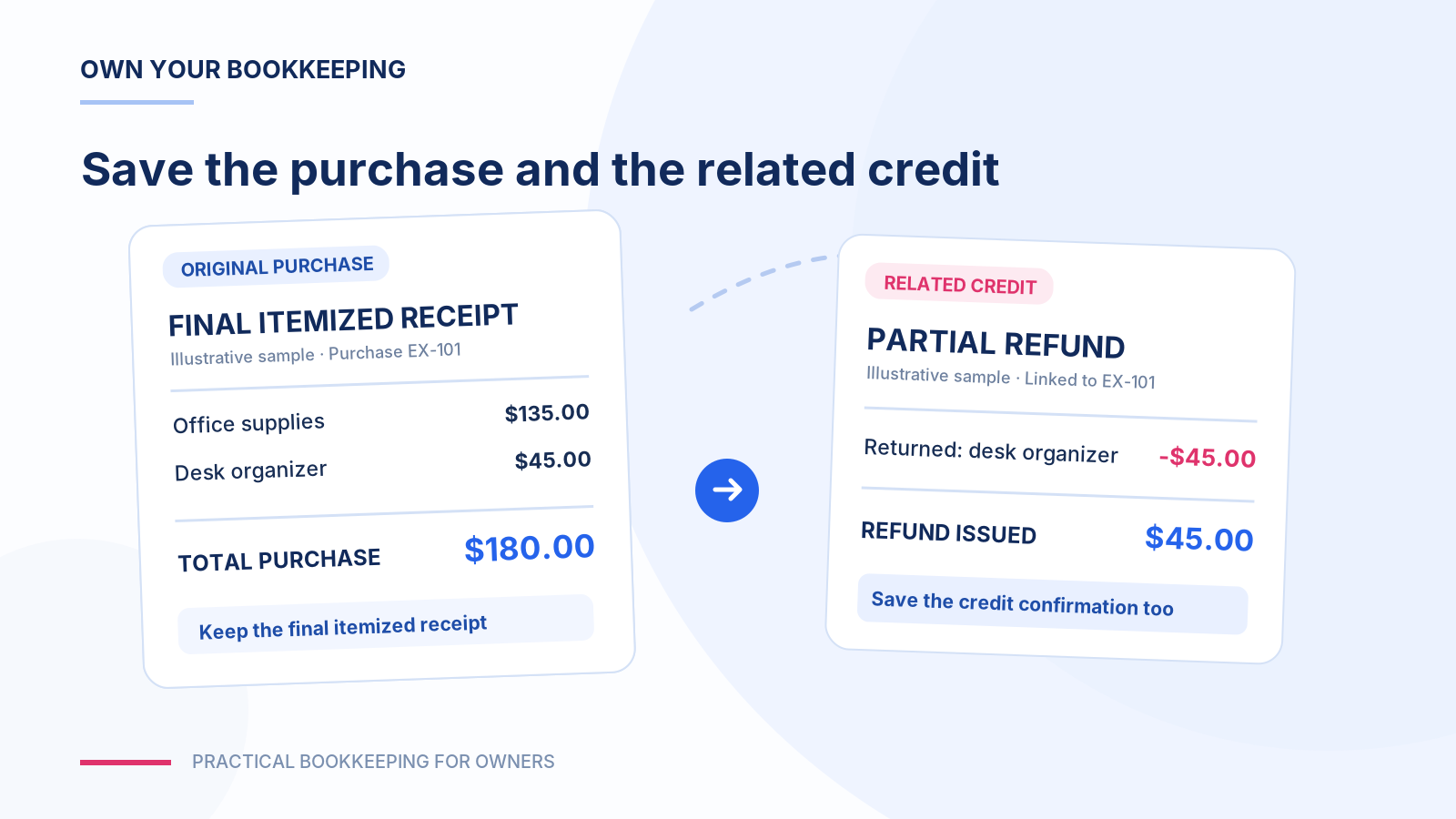
And if the seller issues a partial refund, keep the credit confirmation with the original purchase record. That way, you have a way to explain why the refund and the initial payment aren't the same amount.
Return policies differ, so a receipt doesn't guarantee you'll get a refund. But missing paperwork shouldn't be the reason you can't even make your case.
2️⃣ When an expensive purchase stops working
A warranty claim is a terrible time to start reconstructing a purchase.
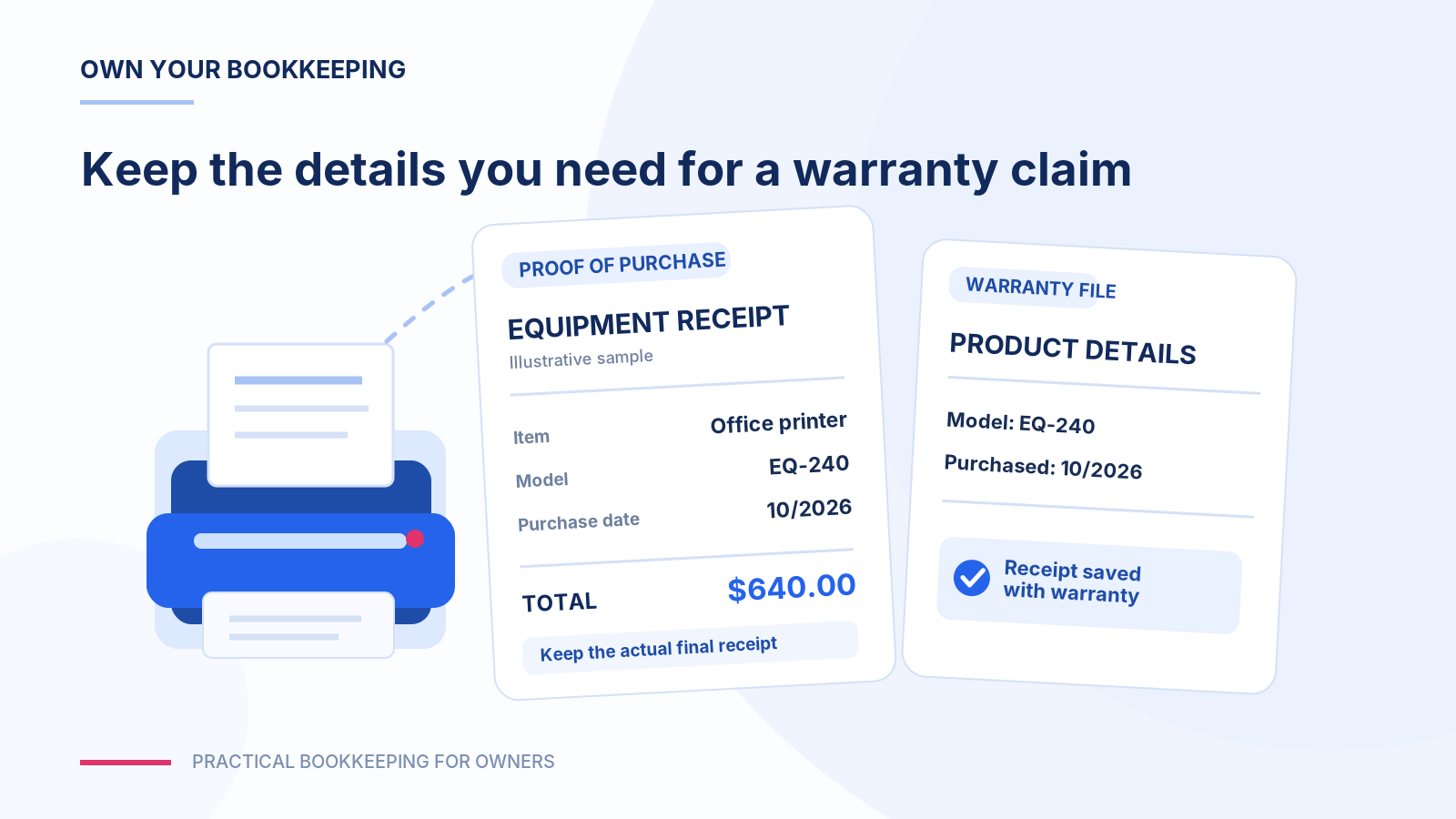
Depending on the manufacturer and the product, you may need the purchase date, seller, model, serial number, or proof of purchase. Some insurance claims also require records supporting the item and its value.
An expense categorized as “Equipment” in your books won't necessarily answer those questions.
Save the receipt or final invoice while you still have easy access to it. Keep relevant warranty information with it. If your business buys equipment that needs service or repair, knowing exactly where that record lives can save an awful lot of back-and-forth later.
3️⃣ When a charge doesn't look right
Here's a situation that's easy to miss: you order supplies for $180, but the final card charge is higher than you expected.
Did shipping change? Was sales tax added? Did you place another order? Was something billed separately?
A bank transaction gives you an amount. The itemized invoice explains what made up that amount.
Or maybe a subscription renews after you thought it had been canceled. Your invoice, cancellation confirmation and the actual billing terms are much more useful than staring at the charge and trying to remember what happened.
Not every unfamiliar or repeated charge is an error. The point is to have the records you need to check it before spending time arguing with a vendor or disputing a payment.
4️⃣ When someone else owes you money
Maybe you buy materials for a client project. Or an employee pays for a business purchase and needs reimbursement.
Now someone other than you needs to see what was purchased and how much it cost.
Depending on the agreement or company policy, an itemized receipt may be required before the expense can be billed back or reimbursed. A credit card total often isn't enough to explain the items.
And if you personally pay for a business purchase, retaining the actual supporting documentation matters even when the bank charge never appears in the business account. Keep personal and business activity properly distinguished. If those transactions are already mixed together, this guide to separating personal and business spending explains that different problem.
A receipt isn't just paperwork for your accountant. Sometimes it's the difference between getting a question answered quickly and chasing the same purchase for the third time.
The business record you actually want isn't always the first email
A saved order confirmation is better than nothing, but the final transaction may change.
Maybe one item was backordered. Maybe shipping was added. Maybe you returned part of the order.
Whenever you can, keep the final itemized receipt or invoice and any related credit or refund record. Check that it relates to the correct purchase. Then save it somewhere you'll look again.
You don't need an elaborate filing system to make this work. A predictable place for purchase records and useful filenames go a long way. If you have bank statements, invoices, receipts and other records scattered together, the five-home business financial records system is a sensible place to start.
I also put together a free one-page Stop Losing Business Receipts guide with a folder layout and filename example you can copy. It's included for free subscribers with this week's Substack article about the business receipt shoebox. Check the article and download after they are published.
And once a week, when you check the transactions in your books, ask one extra question: Could I produce the document behind this purchase if someone needed it tomorrow?
That's a much better test of your recordkeeping than whether you have a folder called “Receipts.”
Frequently asked questions
-
A statement shows the payment, but it may not show the individual items, final invoice details, warranty information or business purpose. Keep the relevant itemized documentation for purchases where that support matters.
-
Not always. An order confirmation often shows what you intended to buy. The final invoice or receipt is more useful when quantities, shipping, taxes, credits or payment amounts changed.
-
A clear, complete photo can be a practical way to retain a record. Make sure the merchant, date, items and amounts are readable, and check any applicable documentation requirements for your situation.
-
Yes, when relevant. Keeping the original purchase, related credits or refunds, and warranty information together makes it easier to understand the complete history of the item.
-
Retention depends on the records involved, applicable requirements, and why you might need them. Ask your tax professional about tax-related retention and follow relevant contract, warranty or insurance requirements rather than assuming every receipt has the same deadline.
Stop treating receipts like a once-a-year problem
You don't need to spend an afternoon organizing every receipt you've ever collected.
But the next time you buy something for your business, save the record that shows what you actually bought, not just the charge that appeared in the bank.
Because the day you'll need that receipt might be a random Tuesday, when a return, repair, refund or reimbursement is on the line.
Want a more dependable place for the records behind your books? Explore OYB Organizer. It's built around organizing business financial records so they're easier to find when you need them.
Get the next post in your inbox.
When a new post goes up, you'll get an email with the link. Nothing else.
Something went wrong. Please try again.
No spam. Unsubscribe anytime.
You're in!
You'll get new Own Your Bookkeeping posts and updates in your inbox.